Marketing, Record Keeping and Economics
India is the third-largest egg producer after China and USA. The overall global demand for eggs is growing, more in India. With rapidly changing lifestyles, affluent culture, and a conscious need for general wellness, Indian consumers are now opting for a more protein-rich diet. The changing trends are definitely a boon for the layer sector in India.
Marketing Channels:
- Producer – consumer
- Producer – Retailer – Consumer
- Producer – Wholesaler – Retailer – Consumer
- Producer – Co-operative society –Retailer - Consumer
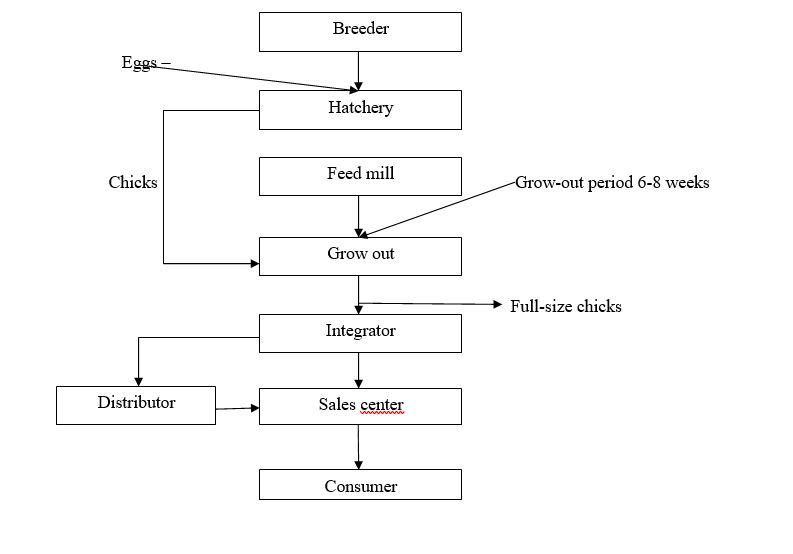
- Integration is the association, coordination, amalgamation of companies engaged in various stages of production of particular product, or related products, so that, there will be a smooth flow of inputs and outputs from one unit to other, leading to overall reduction in the cost of production of the final product
- The poultry farmers are acting only as contract growers receiving commission for the eggs, broilers and turkeys produced by them. The farmers are not the owners of the birds, but the integrators are the real owners.
Schematic diagram of poultry marketing
Government Authorities:
Govt. Agencies involved in poultry marketing (Export)
- Agricultural and Processed Food Products Export Development Authority (APEDA) – http://www.apeda.gov.in
- Export Inspection Council (EIC) and Export Inspection Agency (EIA) – http://www.eicindia.gov.in
- Director General of Foreign Trade – http://dgft.gov.in/
Non-Government Authorities:
- National Egg Coordination Committee (NECC)
- Broiler Coordination Committee (BCC)
- Broiler marketing Cooperative Society (BROMARK)
Record Keeping in Poultry Farming
Record keeping is a necessary element of good poultry business management. If farmers have farm records, they can tell how well they are managing their farm in comparison to other farmers. The strengths and weaknesses in their farm operations can also be noted through record keeping. It is also important to have accurate facts and figures when borrowing money, seeking government loans and tax returns. It is advised to maintain the following records.
Equipment Register
- This includes various farm equipment machineries like feed mill, vehicles, cages, incubators, feeders, waterers etc.
- The date, source, number and cost of purchase of equipment must be recorded.
Feed and feed ingredient register
- Feed is the major item of expenditure in poultry production. Hence, much care should be exercised in maintaining this register.
- Few pages must be allotted for each feed ingredient of the feed.
Feed additives and medicines register
- This register keeps track of the various feed additives, medicines, vaccines, disinfectants, chemicals purchased and utilized.
Layer farm register
- For each batch, the production performance register has to be maintained from day one to disposal; with the following columns.
- Date, age in days, opening balance of birds, mortality, feed issued, feed/ bird/ day, eggs produced, % Hen-day egg production, Feed/ egg and remarks.
- The remarks column should deal with date of vaccinations, debeaking, medication, post-mortem report if any, sale of culled birds and any other relevant information.
Egg out turn register
- This is a consolidated record of egg turnover by all batches maintained in the farm at a time.
- This will take into account the eggs produced by all the batches of layers in the farm.
- Number and sale price of the pullet eggs and broken saleable eggs may also be maintained.
- Moreover, the day-to-day sale price of eggs must be recorded daily.
Broiler farm records
- The regular data to be recorded are date, age in days, opening balance of birds, mortality, total feed issued and remarks.
- In the remarks column the medication and vaccination details, cause of death may be indicated.
Hatchery records
- The hatchery should maintain a date, opening balance, receipts, settings, discards and sales, chicks produced, chicks sold, chicks discarded, free chicks and remarks.
Chick out turn and disposal register
- This register consists of strain wise chick out turn and disposal particulars, consisting of date, opening balance of chicks, chicks hatched, chicks sold, chicks used for own purpose, chicks discarded, chicks given as free margin, closing balance, price per chick and remarks.
Commercial Poultry Project Report
A commercial poultry project report outlines the technical and financial feasibility of a poultry farm,
such as a 10,000-bird broiler or 5,000-bird layer unit. It typically requires an initial capital
investment of ₹15 to ₹30 lakh and targets a Benefit-Cost Ratio (BCR) of 1.10 to 4.17, aiming for a
Return on Investment (ROI) of 20% to 40%.
A bank-ready Detailed Project Report (DPR) requires specific local and operational parameters to secure
financing and ensure a successful venture. Key sections include:
1. Executive Summary & Objectives
- Objective: Establish a commercial farm to produce high-quality protein (meat or eggs) to meet local market demands.
- Target Audience/Market: Wholesale meat vendors, local supermarkets, and hospitality businesses.
2. Technical Specifications
- Capacity: Commonly scaled to 5,000, 10,000, or 20,000 birds per cycle.
- Housing System: Deep litter system or Environmentally Controlled (EC) cages to manage temperature, humidity, and biosecurity.
- Batch Cycle: 6-8 weeks for broilers (typically 5 to 6 batches per year).
- Feed Conversion Ratio (FCR): An optimal standard of 1.5 : 1 to 1.7 : 1 (Amount of feed needed to yield 1 kg of meat).
3. Project Cost Breakdown (Indicative)
Costs vary based on location and scale, but a standard 10,000-bird broiler facility includes:
- Land & Site Development: Needs access to roads, water, and electricity (approx. 1-2 acres).
- Land & Site Development: Needs access to roads, water, and electricity (approx. 1-2 acres).
- Civil Construction: Shed construction, feed storage, and labor quarters.
- Equipment: Feeders, drinkers, brooders, lighting, and ventilation systems.
- Working Capital: Cost of day-old chicks, feed, medicines, and electricity for the first two cycles.
4. Financial Projections
- Revenue Streams: Sale of live birds, eggs, and organic poultry manure (valuable as agricultural fertilizer).
- Operating Expenses: Day-old chicks, maize/soy-based feed, veterinary vaccines, and electricity.
- Financial Indicators: Projects the Internal Rate of Return (IRR), Break-Even Point (BEP), and Debt Service Coverage Ratio (DSCR) to prove commercial viability to lenders.
5. Government Schemes & Financing
In India, financial assistance and subsidized term loans are available through the National Bank for Agriculture and Rural Development (NABARD) and various state animal husbandry departments.
To generate a highly specific, bank-ready document customized to your local market, you can use the Finline Project Report Generator or review standard templates from the National Institute of Agricultural Extension Management (MANAGE). [1]
The farmers/entrepreneurs may get more details from the below mentioned organizations/programmes.
The interested farmers/entrepreneurs may follow
POULTRY PROJECT PROPOSAL FOR BANK LOAN
| Name of the Farmer |
: |
| Address of Farmer |
: |
| Name of the Bank |
: |
| Location of the Farm |
: |
| Details and experience of Farmer |
: |
| Details of the Infrastructure |
: |
| Details of Marketing |
: |
| Total Project outlay |
: |
| Margin Money |
: |
| Proposed Bank Loan |
: |
| Details of the project proposal |
: |
| Repayment schedule |
: |
This is to certify that this project proposed for Farmer and is economically feasible and viable.
Poultry Project Report for 5000 broilers with batches at 7 days interval
A. NON RECURRING EXPENDITURE:
| 1. Land |
Available |
| 2. Fencing |
|
| 2. Water |
|
| 3. Buildings |
|
| a. Shed |
|
| b. Office cum store |
|
| c. Staff quarters |
|
| d. Equipments |
|
| e. Water& Electrification charges |
|
| Total |
|
B(a).RECURRINGEXPENDITURE(0–6WEEKS):
| 1. Cost of Day old chicks | |
| 2. Cost of Feed | |
| 3.Brooding &Medicine Expenses | |
| 4. Labour | |
| 5.MiscellaneousExpenses | |
| Total | |
B(b).RECURRINGEXPENDITURE(0-5WEEKS):
| 1. Cost of Dayold chicks | |
| 2. Cost of Feed | |
| 3.Brooding&MedicineExpenses | |
| 4. Labour | |
| 5.MiscellaneousExpenses | |
| Total | |
B(c).RECURRINGEXPENDITURE(0-4WEEKS):
| 1. Cost of Day old chicks | |
| 2. Cost of Feed | |
| 3.Brooding&MedicineExpenses | |
| 4. Labour | |
| 5.MiscellaneousExpenses | |
| Total | |
B(d).RECURRINGEXPENDITURE(0-3WEEKS):
| 1. Cost of Day old chicks | |
| 2. Cost of Feed | |
| 3.Brooding&MedicineExpenses | |
| 4. Labour | |
| 5.MiscellaneousExpenses | |
| Total | |
B(e).RECURRINGEXPENDITURE(0-2WEEKS):
| 1. Cost of Day old chicks | |
| 2. Cost of Feed | |
| 3.Brooding&MedicineExpenses | |
| 4. Labour | |
| 5.MiscellaneousExpenses | |
| Total | |
B(f).RECURRINGEXPENDITURE(0-1WEEKS):
| 1. Cost of Day old chicks | |
| 2. Cost of Feed | |
| 3.Brooding&MedicineExpenses | |
| 4. Labour | |
| 5.MiscellaneousExpenses | |
| Total | |
| Total RecurringExpenditure |
|
| +Non RecurringExpenditure(A) |
|
| Total Expenditure |
|
| Bank Loan amount @80% of total expenditure |
|
| Farmer’s Contribution Remaining20% |
|
D. GROSS INCOME:
| 1.Sale of Live birds (2%mortality) |
|
| 2.Sale of Manure (1ton/5000 birds) |
|
| 3.Sale of Gunny bags |
|
| Total |
|
| E.GROSS PROFIT: |
(D-B(a)) |
| F. GROSS PROFIT/YEAR: |
|
G. DEPRECIATION:
| 1.Bank Interest @12% per annum |
|
| 2.Depreciation on building5% |
|
| 3.Depreciation on equipments 10% |
|
| 4.Farm Manger Salary |
|
| Total |
|
| H.NET PROFIT PER YEAR: |
F –G |
| I.NET SURPLUS: |
|
REPAYMENT SCHEDULE OF LOAN
Sl.
No. |
Particulars |
I year |
II year |
III year |
IV year |
V year |
| 1. |
Gross Profit |
| | | | |
| 2. |
Loan amount |
| | | | |
| 3. |
Interest on loan |
| | | | |
| 4. |
Depreciation on building 5% |
| | | | |
| 5. |
Depreciation on equipment 10% |
| | | | |
| 6. |
Farm Manager Salary |
| | | | |
| 7. |
Net Profit(1-3+4+5) |
| | | | |
| 8. |
Loan repayment |
| | | | |
| 9. |
Loan Balance(2-8) |
| | | | |
| 10. |
Net surplus(7-8) |
| | | | |
| 11. |
Cost of building |
| | | | |
| 12. |
Cost of equipment |
| | | | |
Assumptions:
- The Bank interest on loan taken is 12%.
- Depreciation on Building and Equipments @ 5% and 10%, respectively.
- Depreciation on Building and Equipments are calculated on the basis of the preceding year value.
- Loan repayment is scheduled for 5 years in equal installments.

