Housing/Night Shelter
The basic requirements of night shelter are:
- Protection from weather
- Protection from predators
- Enough space to move around
- Adequate ventilation
- A clean environment
- Helps in converting poultry litter into manure
- Ensure reduced risk of diseases.
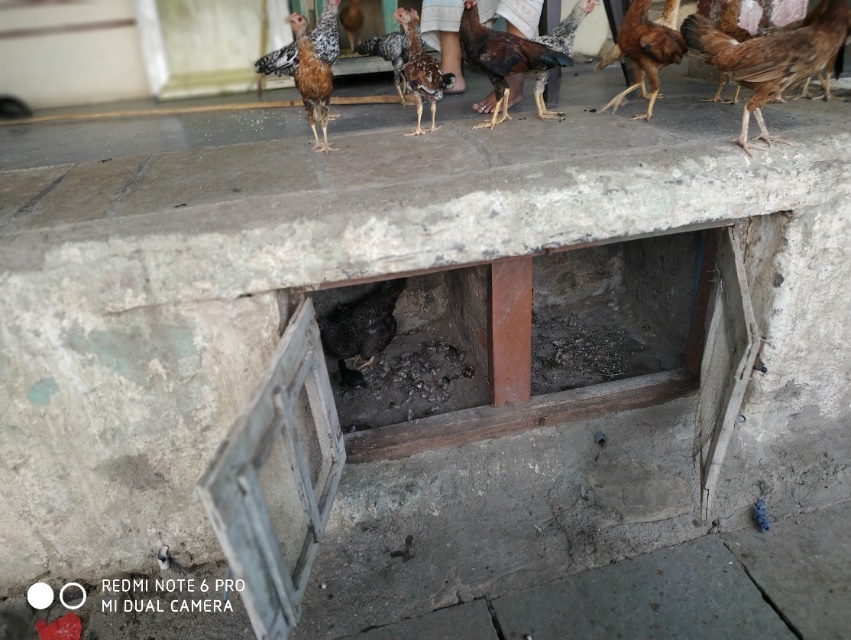
Backyard poultry housing
The following points would help in constructing the night shelter for
the birds in backyard system of rearing.
-
Utilization of locally available low cost resources like bamboo,
wooden planks, polythene sheets etc. which will be easily available
and involves minimum expenditure.
-
Build the night shelter for the birds on higher, well-drained areas in
order to prevent prolonged dampness and water saturation of the floor
and outside areas. A shelter few inches above ground is preferred.
- Provide adequate space per bird and avoid overcrowding.
-
For laying hens, a darkened, raised secure nesting area with nests
containing clean nesting material should be available. Nests can be in
the fenced area or in the shelter itself.
-
Hens lay more eggs if artificial light is available in the morning and
evening to give 15 to 16 hours of light each day.
-
Remove any loose or projecting wire, nails, or other sharp-edged
objects or projections from the house and run to avoid injuries.
-
Provide a comfortable and stress free environment with optimum
temperature, fresh air and sufficient light.
-
A night shelter consisting of size- 4.0 ft length x 3.0 ft width x 3.5
ft height will be sufficient for 10 birds. The shelter should be
1.5-2.0 ft above the ground for keeping the floor dry. The roof should
be weather proof and sloping down from 3.5ft to 2.5 ft edge above
floor level.
-
Arrangements should be made inside for drinker and feeder in the front
and nests/basket must be arranged at the back corner of the shelter.
| Age (weeks) |
Floor space (sq. ft) |
Feeding space (cm) |
Watering space (cm) |
| 0-4 |
0.5 |
2.5 |
1.5 |
| 4-8 |
1.0 |
5.0 |
2.0 |
| 8-12 |
2.0 |
6.5 |
2.5 |
Poultry farming systems
- Deep Litter system.
- Cage System.
1. Deep Litter system
- In this system, chickens are raised indoors. The house should be 28 feet wide and the ventilation system should be good.
- About 3-4 inches thick litter material is placed on the floor (litter material - rice husk, wood dust, powdered millet, grass, sugarcane husk, etc.). Litter is a cushioning material for chickens, keeps the floor of the chicken house dry and absorbs moisture from the chicken droppings, acts as a heat insulator and also provides some vitamins to the chickens.
- However, care should be taken not to let water fall on the litter material. If water is spilled, the wet part of the litter should be removed immediately and replaced with dry litter.
Advantages of the deep litter system
- It is cool in summer, warm in rainy and winter season.
- Chickens are comfortable in all weathers.
- Ammonia gas does not spread inside the house.
- The litter absorbs the moisture of the chicken droppings, which reduces the ammonia gas produced by the droppings and prevents the problem of flies.
- The rate of egg breakage is low in this system.
- After the chickens are sold, the litter can be sold or used as fertilizer.
- When chicken droppings are added to the thick litter, vitamins B-2 and B-12 are produced in it due to the action of chemicals and bacteria. Eating this by the chickens helps in their growth.
Disadvantages of the deep litter system
- The crowding of chickens during feeding causes the feed to fall into the litter and spoil.
- The need for food increases as the chickens move around a lot.
- Chickens fight and injure each other.
- Chickens are more susceptible to parasites.
- Litter dust causes respiratory problems for chickens.
- It is difficult to identify and separate diseased chickens, so the disease is more likely to spread.
2.Cage System
Cage farming is a modern type of poultry farming. In this system, a large number of chickens can be raised in a small space. But usually in backyard poultry farming, cage system is not followed.