Health Care
- Birds should be vaccinated against important diseases like Marek’s disease, Ranikhet disease, fowl pox etc. to
develop immunity against these diseases.
- Regular deworming of birds for internal parasites is very important due to scavenging nature of birds.
- Although debeaking of birds is not encouraged in rural poultry production since it helps in foraging and
scavenging, but debeaking may be followed if the farmer is rearing about 80-100 or more birds to avoid
cannibalism, egg biting etc.
- After first deworming, repeat at 3 week intervals so as to give a total of 4 dewormings.
- While medicating through drinking water, it should be done by mixing the required quantity of medicine as per
veterinarian’s advice in the quantity of water that chicks normally consume in 4 hours’ time (approximately 6
litres per 100 birds of 6 week-old per day).
- Additional water should be given only when all the medicated water is consumed by the chicks.
- On the slightest indication of external/ectoparasites, the birds should be dusted or dipped and houses
fumigated.
- While dipping, care should be taken to avoid head dipping and avoid dipping during rainy days.
- Always follow advice of veterinarians and manufacturer’s instructions to avoid health hazards.
The schedule for deworming and debeaking is as below.
| Age |
Programme |
| 31-42 days |
First debeaking |
| 42-50 days |
First deworming |
| 13-16 weeks |
Second debeaking and second deworming |
Recommended Vaccination schedule for backyard poultry
| Age |
Name of the vaccine |
Strain |
Dose |
Route |
| 5th day |
Newcastle Disease |
Lasota |
One drop |
Eye drop |
| 14thday |
Infectious Bursal Disease |
Georgia |
One drop |
Oral drop |
| 21st day |
Pox |
Fowl pox |
0.20 ml |
S/C injection |
| 28thday |
Newcastle diseases |
Lasota |
One drop |
Oral drop |
| At Backyard |
| 9thweek |
Newcastle diseases* |
R2B |
0.5 ml |
S/C injection |
| 12thweek |
Pox* |
Fowl pox |
0.5 ml |
S/C injection |
*Repeat these two vaccines at every six months interval
Note: The first day vaccination for Marek's disease is generally undertaken at hatchery itself.
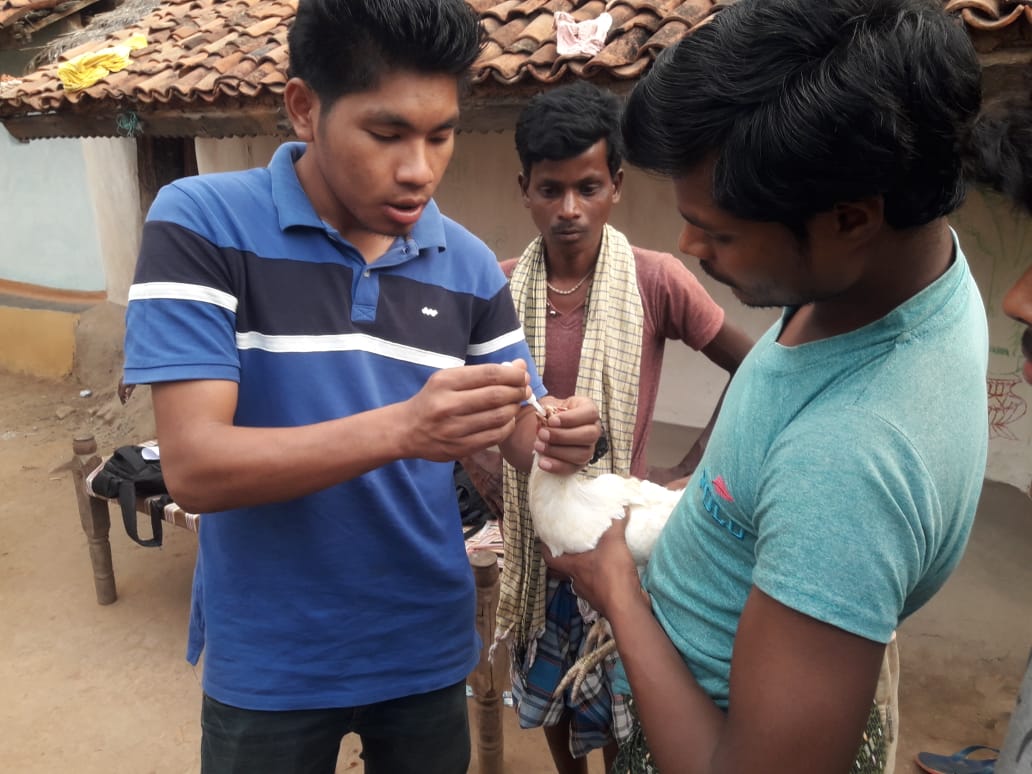
Vaccination of backyard poultry (Source: Mr. Alekha Dalai)
As a precautionary measure, avoid rearing of different species of poultry (like rearing chicken with ducks,
turkeys etc.), keep young stock away from adult stock, keep the poultry houses and equipments clean, follow proper
disposal of dead birds, prevent entry of rodents etc.to check the diseases. Biosecurity, even-though demands some
amount of investment, ensures diminished losses due to infection and good quality production.
Diseases of Backyard poultry
1. Chronic respiratory disease
- This disease is caused by the pathogen Mycoplasma gallisepticum.
- Chicks are susceptible to this disease, which spreads equally to chickens of all ages.
- The disease is spread by heredity, mutual mating, environment, air and equipment.
Symptoms:
- Watery nose, sneezing and coughing, which cause extreme difficulty in breathing.
- The yield of egg-laying chickens is greatly reduced.
2. Raniketh disease
- This is a disease caused by APMV-1 virus.
- There is no medicine to cure this disease, so vaccination should be given before the disease occurs.
Symptoms:
- It occurs in all chickens simultaneously.
- Chickens have difficulty breathing, develop greenish discharge and have a stiff neck and head due to nervous weakness.
- Death occurs within 2-3 days of the disease.
- The yield of laying hens is greatly reduced.
3. Infectious Bursal Disease
- This disease causing viruses (IBDV) are found in the first 2 weeks of age of chicks.
- It completely destroys the body's immune system and white blood cells.
- There is a possibility of transmission from mother hens to chicks through eggs.
Symptoms:
- Watery diarrhoea and bites the anal area.
- The growth of chicks is stunted.
4. Chicken Infectious Anemia
- When this viral disease occurs, chickens start dying in groups.
- Moisture helps in the rapid spread of this disease to other chickens through the droppings of chickens with this disease.
Symptoms:
- Blood is found in the droppings.
- If medicine is not given within 24 hours of the disease, chickens die in large numbers.
- The yield of laying hens is greatly reduced.
Prevention measures:
- Healthy and well-immunized chickens should be used for breeding.
- Before purchasing chickens, their parents should be disease-free and ensure that the chickens have been vaccinated against diseases.
- Chickens and adult chickens should be vaccinated regularly to prevent diseases.
- Young chickens should not be left with adult chickens.
- If there is a difference in the health of the chickens, veterinary advice should be sought immediately.
Parasites and their prevention
1. Internal parasites
- Roundworms and tapeworms are usually found in the intestines of chickens, due to which the food eaten is not digested properly and the chickens die of exhaustion and egg production decreases.
Prevention: Chickens should be given insecticides from time to time.
2. External parasites
- Chicken lice, fleas, etc. are found on the upper body of backyard chickens.
Prevention: External parasites should be sprayed on the body parts of the chicken by mixing powder or insecticide with water. Along with this, the environment of the chicken house should be kept clean.
Disposal of dead chickens
- Chickens usually die from diseases sometimes. In India, a little less than 5% die annually. Dead chickens should be immediately separated from the flock and buried in a pit.
Burial pit for dead chickens
- This pit should be about 150 feet away from other chicken houses, living quarters and from the water source where the chickens roam.
- The pit for burying dead chickens should be about 6 feet x 6 feet x 8 feet in size. It can be used for about years. It should be covered. Closing this lid will prevent the dead chickens from rotting inside without air. Once this pit is full, it should be closed permanently. Doing so will prevent infection from spreading to other chickens and reduce the death rate.